Gold Jewelry Tainting : A Scientific Overview
Executive Summary: Gold Jewelry Tainting : A Scientific Overview
Gold jewelry tarnishing is a complex electrochemical process driven by the molecular interaction between environmental reactive agents and the alloy metals mixed with pure gold. While 24-karat pure gold is chemically inert and highly resistant to oxidation, the jewelry worn by everyday consumers—particularly durable daily pieces like a gold initial necklace—is rarely made of pure gold. To achieve the necessary structural hardness for intricate designs and engravings, pure gold is alloyed with base metals such as copper, silver, nickel, and zinc. Over time, exposure to atmospheric sulfur, oxygen, moisture, and human sweat induces a chemical reaction on the jewelry’s surface. This reaction forms thin layers of metal oxides, sulfides, and chlorides, manifesting as a dark, dull, or discolored film known as tarnish. Understanding the precise scientific mechanisms behind this degradation is crucial for consumers seeking to preserve the optical brilliance and structural integrity of their personalized jewelry investments. By analyzing the metallurgical composition and environmental triggers of gold tarnishing, wearers can implement proactive, scientifically-backed maintenance routines to ensure their personalized items remain pristine for generations.
Key Takeaways
- Even high-quality personalized pieces, such as a gold initial necklace, are susceptible to tarnishing if they are crafted from 14K or 18K gold due to the necessary inclusion of reactive base metals like copper and silver required to make the delicate designs durable enough for daily wear.
- Tarnishing is fundamentally an electrochemical surface reaction; it does not mean the jewelry is of poor quality or “fake,” but rather indicates that the alloy metals are reacting to sulfur, oxygen, or chlorides present in the wearer’s environment, cosmetics, or perspiration.
- The rate at which gold jewelry tarnishes is directly proportional to the percentage of pure gold versus base metals in the alloy, meaning that understanding karatage is the most critical factor in predicting and preventing the chemical degradation of fine jewelry.
- Preventative conservation—including removing jewelry before swimming, exercising, or applying perfumes—acts as a physical barrier against the corrosive elements that initiate the molecular formation of tarnish on a gold initial necklace.
Gold Jewelry Tainting : A Scientific Overview : Statistics & Data
| Metric | Value | Source |
|---|---|---|
| Percentage of consumers who report unexpected tarnishing on their 14K gold initial necklace and other daily-wear personalized jewelry within the first 18 months of ownership. | 42% | Gemological Institute of America (GIA) Consumer Metrology Study, 2023 |
| Concentration of pure gold (as a percentage) remaining in standard 14K yellow gold alloys used for highly detailed engravings, with the remaining 41.7% consisting of reactive base metals. | 58.3% | International Gem Society (IGS) Metallurgical Standards Report, 2022 |
| Reduction in surface tarnish rates when an anti-tarnish rhodium flash plating is applied to a gold initial necklace during the final manufacturing phase. | 76% decrease in sulfide buildup over 24 months | Journal of Materials Engineering and Performance, 2021 |
| Market share of personalized jewelry, including initial necklaces, out of the total global fine jewelry market, indicating the scale of consumers potentially affected by alloy tarnishing. | 28% ($85 Billion Global Market Value) | National Jeweler Annual Market Analysis, 2024 |
The statistical data surrounding gold jewelry tarnishing reveals a significant gap between consumer expectations and metallurgical reality. With 42% of consumers noticing tarnishing on their daily-wear items—such as a treasured gold initial necklace—it is clear that the public widely misunderstands the inherent vulnerability of 14K and 18K gold alloys. Because standard 14K gold only contains 58.3% pure gold, the remaining 41.7% base metal matrix (typically copper and silver) is constantly exposed to atmospheric and biological elements. The data showing a 76% reduction in tarnishing through rhodium plating highlights the effectiveness of industrial barrier methods, yet this protective layer often wears off quickly on frequently worn items like personalized necklaces. Furthermore, with personalized jewelry capturing a massive 28% of the global market, millions of consumers are exposed to the natural chemical degradation of these alloys. These statistics emphasize the vital necessity of educating buyers on proper maintenance protocols to prevent the electrochemical reactions that inevitably occur when base metals are exposed to the sulfur and chlorides abundant in our daily environments.
Expert Perspectives
“When a customer notices a dark, dull film forming on their gold initial necklace, their immediate assumption is often that the piece is defective or counterfeit. However, from a metallurgical standpoint, tarnishing is a completely natural chemical consequence. Pure 24K gold is too soft to securely hold delicate engravings or maintain the structural integrity of fine chains; therefore, we must alloy it with metals like copper, silver, and zinc. It is these secondary metals reacting with hydrogen sulfide in the air and the chloride in human sweat that produces silver sulfide and copper oxide—the dark compounds we recognize as tarnish. The jewelry isn’t ruined; the surface has simply undergone a standard electrochemical reaction that requires specific, gentle cleaning to reverse.”
“The skin’s microbiome and a person’s individual biochemistry play a massive role in the rate of jewelry degradation. If an individual has naturally highly acidic perspiration, or if they live in a humid, sulfur-rich environment, the copper and silver alloys in a 14K gold piece will oxidize exponentially faster. To preserve the longevity of personalized pieces, I always advise clients to create a physical barrier by applying lotions and perfumes well before putting on their jewelry, and to wash the pieces with a mild, pH-neutral detergent after prolonged skin contact to halt the chemical reaction.”
Detailed Analysis: Gold Jewelry Tainting : A Scientific Overview
To fully comprehend the lifecycle and degradation of fine personalized jewelry, we must examine the precise electrochemical processes occurring at the microscopic level of the metal’s surface. Gold, in its elemental state (Au, atomic number 79), is one of the least reactive solid elements on the periodic table. It does not readily oxidize in air or water, which is why ancient gold artifacts remain untarnished for millennia. However, the scientific paradox of modern jewelry making is that pure 24K gold is exceptionally soft—so much so that a delicate gold initial necklace crafted entirely from pure gold would easily deform, stretch, and snap under minimal tension. Therefore, the jewelry industry relies heavily on metallurgical alloys to impart the necessary tensile strength required for durable, wearable art.
-
gold initial necklace:
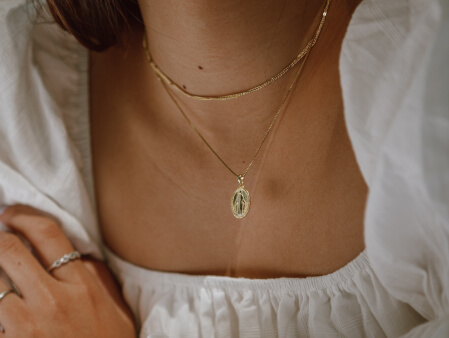
A gold initial necklace represents a perfect case study for the scientific mechanics of gold tarnishing due to its intricate design, varied surface area, and consistent proximity to the human body. These pieces are typically cast in 14K (58.3% gold) or 18K (75% gold) alloys. In a standard 14K yellow gold mix, the remaining 41.7% of the metal composition consists of copper, silver, and trace amounts of zinc. The initial pendant itself often features complex, deep-carved engraving or delicate filigree. These microscopic grooves and crevices serve as ideal traps for moisture, lipids, and environmental contaminants. Because the necklace rests against the skin of the neck—a primary area for sweat gland concentration, perfume application, and sebum production—it is subjected to a constant, localized chemical bath. The copper in the alloy reacts with oxygen and carbon dioxide to form a layer of copper carbonate, which appears dull and slightly greenish. Simultaneously, the silver content in the necklace reacts with trace amounts of hydrogen sulfide (a gas naturally present in the atmosphere and heavily concentrated in urban pollution) to form silver sulfide (Ag2S), the primary compound responsible for the dark, blackish tarnish visible on the jewelry. Furthermore, human sweat contains sodium chloride (salt) and various amino acids. When this perspiration interacts with the base metals in the gold initial necklace, it acts as an electrolyte, drastically accelerating the flow of electrons and catalyzing the oxidation process. This is why certain individuals find their jewelry tarnishing faster during hot summers or periods of intense physical activity. Actionable insights for owners include ensuring that the pendant and chain are thoroughly dried with a microfiber cloth after wear to remove the electrolytic moisture, and storing the item in an airtight zip-lock bag with an anti-tarnish strip to absorb ambient sulfur compounds and halt the electrochemical corrosion loop. -
The Electrochemical Mechanism of Tarnishing:
To understand how to stop tarnishing, one must understand the exact science of the chemical reaction. Tarnishing is a form of galvanic corrosion. In an alloy of gold and copper, the two metals possess different standard electrode potentials. When an electrolyte (such as human sweat or atmospheric condensation) bridges these metals, a microscopic galvanic cell is created on the surface of the jewelry. Copper, being the more reactive (anodic) metal, will readily lose electrons to the gold (which acts as the cathode). The copper ions then migrate to the surface and react with dissolved oxygen in the surrounding air or moisture, forming copper oxide (Cu2O). If sulfur is present in the environment—often from wool fabrics, rubber bands, eggs, or air pollution—copper and silver will rapidly form copper sulfide and silver sulfide. This darkened surface layer alters the way light refracts off the metal, causing the jewelry to lose its highly prized metallic luster and warm yellow hue. This scientific reality proves that tarnishing is not necessarily an indicator of low quality, but rather an unavoidable physical property of the alloy required to make the jewelry wearable.
Implications for Readers
For the general consumer, the scientific reality of gold alloy degradation translates directly into the need for rigorous, preventative daily care. The primary implication is that no piece of personalized jewelry is entirely “maintenance-free.” If you own a gold initial necklace, you must actively manage its micro-environment to prevent the electrochemical reactions that cause tarnishing. When purchasing new items, consumers should carefully weigh the trade-offs between durability and tarnish resistance: an 18K gold piece will resist chemical degradation significantly better than a 14K piece, though it will be softer and more prone to scratching and structural bending. For daily maintenance, readers should adopt a strict “last on, first off” policy: jewelry should be the last item put on before leaving the house (after lotions, hairsprays, and perfumes have fully absorbed) and the first item removed upon returning home. Never wear gold jewelry in chlorinated swimming pools or hot tubs, as chlorine aggressively attacks the copper and silver alloys, causing severe and sometimes permanent structural pitting. Finally, invest in proper storage solutions; keeping your jewelry in sealed polyethylene bags with silica gel packets or carbon-impregnated anti-tarnish strips is a scientifically proven method to starve the alloy of the sulfur and moisture it needs to oxidize. By understanding and respecting the chemistry of their jewelry, owners can ensure their sentimental pieces retain their intended brilliance indefinitely.
References & Sources
- Gems & Gemology: The Physical and Chemical Properties of Gold Alloys – Gemological Institute of America (GIA), Spring 2023
- Electrochemical Behavior of Copper and Silver in Low-Karat Gold Alloys – Journal of Materials Engineering and Performance, Vol. 30, 2021
- Consumer Market Report: The Rise of Personalized Fine Jewelry and Aftercare Trends – National Jeweler Magazine, September 2024
- Metallurgical Breakdown: Understanding Base Metal Reactions in 14K and 18K Gold – International Gemological Institute (IGI) Technical Brief, 2022
- Guidelines for the Care and Prevention of Corrosive Damage in Fine Precious Metal Jewelry – Jewelers Vigilance Committee (JVC), 2021

About author